The Economics of Injection Mold Tooling in Toy Manufacturing
In high-volume plastic toy production, mold tooling represents the single largest initial capital investment. Yet, many sourcing directors lack visibility into the engineering variables that dictate mold pricing, operational lifespan, and unit part costs.
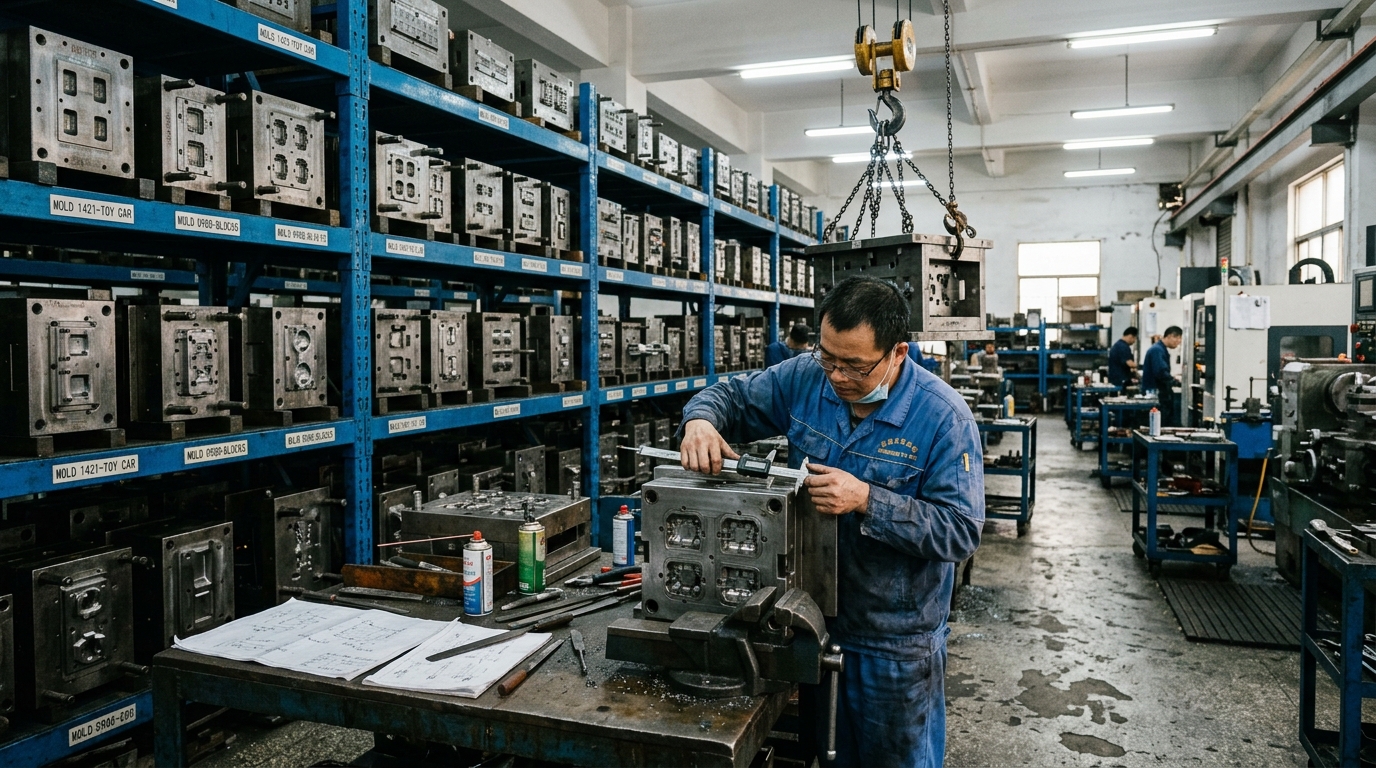
At WishTime Toys, our in-house mold fabrication workshop houses over 1,200 active steel molds. By eliminating external mold brokers and managing CNC machining, wire EDM cutting, and polishing in-house, we reduce tooling costs for OEM clients by 35% to 45% while compressing T1 sampling timelines down to 15–20 business days.
Selecting Tooling Steel: NAK80 vs S136 vs P20
Selecting the correct mold steel is critical to balancing upfront investment against expected production volume:
- **P20 Steel (Pre-hardened, 28–32 HRC)**: Cost-effective steel suitable for low-volume promotional toys or large structural chassis parts. Lifespan is rated for 200,000 to 300,000 shots. Susceptible to corrosion from acidic polymers or fire-retardant additives.
- **NAK80 Steel (Pre-hardened, 37–43 HRC)**: The industry workhorse for high-precision consumer toys. Delivers exceptional mirror polishability, uniform hardness, and excellent dimensional retention. Ideal for intricate geared assemblies and highly detailed character figurines. Lifespan: 500,000+ shots.
- **S136 Stainless Mold Steel (Through-hardened, 48–52 HRC)**: Premium Swedish-grade martensitic stainless steel with superior corrosion resistance and mirror-finish capability. Mandatory for optical clear lenses, bubble maker fluid chambers, and food-grade silicone baby teething molds. Lifespan: 1,000,000+ shots.
Cavity Optimization Math & Tooling Cost Amortization
Calculating the optimal number of mold cavities is a mathematical trade-off between upfront tooling expense and per-unit molding efficiency:
$$\text{Total Unit Cost} = \frac{\text{Tooling Cost}}{\text{Total Order Volume}} + \text{Material Cost} + \frac{\text{Hourly Machine Rate}}{\text{Cavities} \times (3600 / \text{Cycle Time})}$$
For a production run of 100,000 units, increasing mold cavities from 2 to 4 might increase tooling costs from $8,000 to $12,500 (+56%), but it cuts machine running hours from 555 hours to 277 hours (-50%), saving over $6,000 in machine time and netting a lower total landed cost.
Official Industry References & Regulatory Standards Mentioned in This Guide:
- Testing & Certification Bodies: SGS International | Intertek Group | TÜV Rheinland | Bureau Veritas
- Toy Safety & Regulatory Directives: ASTM F963-23 Standard | European Commission Toy Safety Directive (EN71) | U.S. Consumer Product Safety Commission (CPSC)
- Factory Social & Quality Audits: amfori BSCI | ICTI Ethical Toy Program (IETP) | Sedex SMETA | ISO 9001:2015
- Industrial Machinery & Global Retail: Haitian International | Sumitomo Heavy Industries | The Toy Association | Maersk Ocean Line