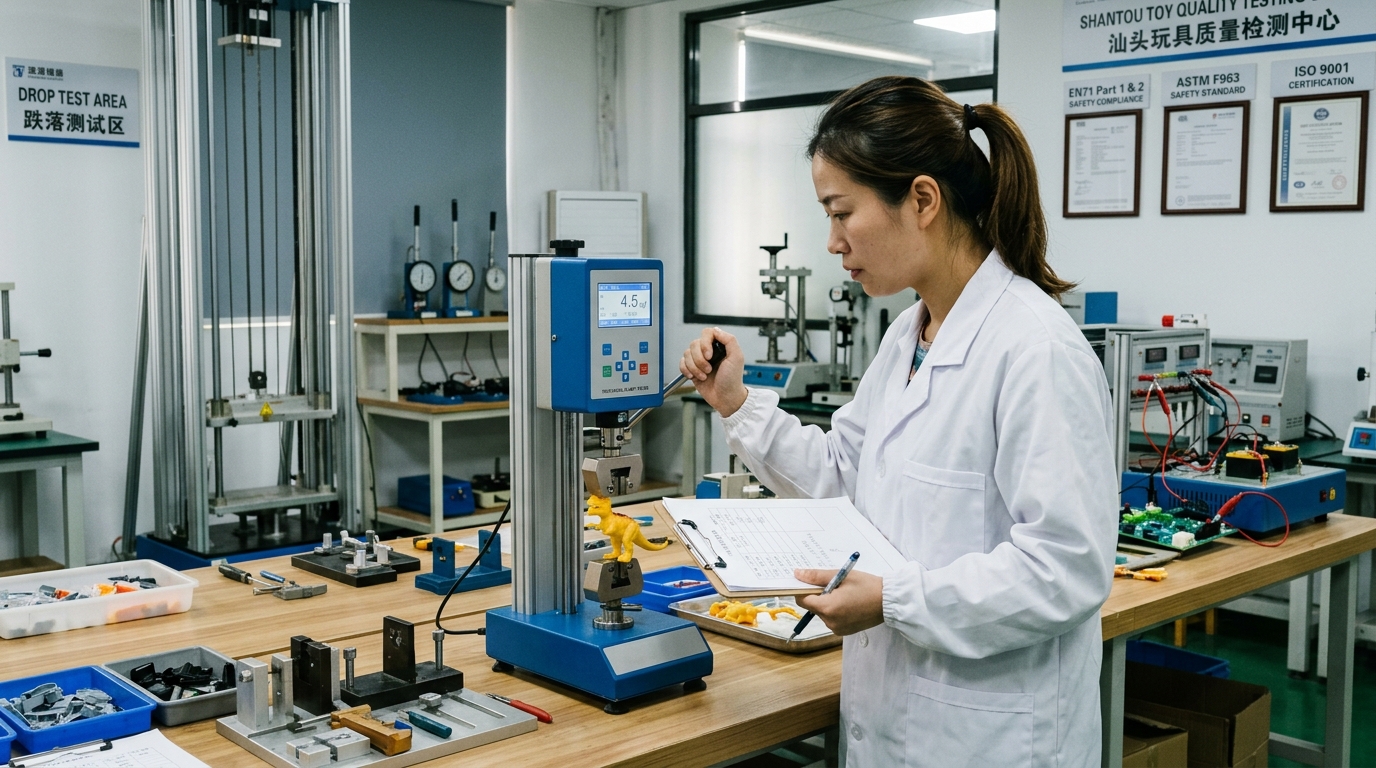
The High Stakes of Toy Safety Compliance
For retail toy buyers and import directors, product compliance is not a regulatory formality—it is a critical business risk. A single failure during customs entry or a post-market recall initiated by the U.S. CPSC or the European Union Safety Gate (RAPEX) can result in six-figure detention fines, inventory destruction, and brand damage.
While both ASTM F963-23 (Standard Consumer Safety Specification for Toy Safety in the United States) and the European EN71 Directive 2009/48/EC share the overarching objective of protecting children from physical, flammability, and toxic hazards, their test methods, migration limits, and legal documentation requirements diverge significantly.
Mechanical & Physical Differences: Drop, Torque, and Small Parts
Key physical differences between the US and European standards include:
1. **Small Parts Choke Tube Testing**: Both standards utilize a truncated cylinder with a 1.25-inch (31.7mm) diameter to define small parts for children under 3 years old. However, ASTM F963 specifically incorporates stringent bite-force testing protocols (Section 8.9), applying up to 50 lbs (222 N) of mechanical clamping force across accessible projections to verify that fragments cannot be bitten off.
2. **Drop Testing Heights & Impact Surfaces**: Under EN 71-1, drop testing is performed from a standardized height of 850mm ± 50mm onto a 4mm steel plate mounted on 10mm concrete. ASTM F963-23 prescribes a more aggressive protocol: toys for children 18 months or younger are dropped 10 times from 4.5 feet (1,372mm) onto vinyl-covered concrete.
3. **Tension and Pull Testing Limits**: EN 71-1 applies a maximum tension force of 90 N for components accessible to infants, whereas ASTM F963 mandates 15 lbf (66.7 N) for children 0–18 months and up to 20 lbf (89 N) for older children.
Chemical Migration: 8 Heavy Metals vs 19 Elements
The most pronounced divergence between American and European toy standards lies in chemical toxicology:
- **ASTM F963-23 (Heavy Elements Specification)**: Regulates the soluble migration of 8 heavy elements: Lead (90 ppm), Antimony (60 ppm), Arsenic (25 ppm), Barium (1,000 ppm), Cadmium (75 ppm), Chromium (60 ppm), Mercury (60 ppm), and Selenium (500 ppm).
- **EN 71-3 (Migration of Certain Elements)**: Substantially more stringent, regulating the migration of 19 distinct chemical elements across three material categories (dry/brittle, liquid/sticky, and scraped-off polymer materials). In particular, limits for Hexavalent Chromium (Cr VI) and organic tin compounds require advanced Inductively Coupled Plasma Mass Spectrometry (ICP-MS) screening.
At WishTime Toys, all raw polymer resin pellets and color masterbatches are pre-screened to satisfy the strictest limits of both jurisdictions simultaneously, allowing a single production batch to be legally distributed in both North America and the European Union.
Legal Documentation: Children's Product Certificate (CPC) vs EC Declaration of Conformity
Importers must prepare distinct legal documentation before goods reach border customs:
- **United States**: The importer of record must issue a Children's Product Certificate (CPC) certifying that the toy complies with ASTM F963-23, CPSIA total lead, and phthalate limits. The CPC must cite test reports issued by a CPSC-accredited third-party laboratory such as SGS or Intertek.
- **European Union**: The manufacturer or EU-based authorized representative must draw up an EC Declaration of Conformity (DoC), compile an extensive Technical Construction File (TCF), and apply the CE conformity mark with full traceability markings.
Official Industry References & Regulatory Standards Mentioned in This Guide:
- Testing & Certification Bodies: SGS International | Intertek Group | TÜV Rheinland | Bureau Veritas
- Toy Safety & Regulatory Directives: ASTM F963-23 Standard | European Commission Toy Safety Directive (EN71) | U.S. Consumer Product Safety Commission (CPSC)
- Factory Social & Quality Audits: amfori BSCI | ICTI Ethical Toy Program (IETP) | Sedex SMETA | ISO 9001:2015
- Industrial Machinery & Global Retail: Haitian International | Sumitomo Heavy Industries | The Toy Association | Maersk Ocean Line